Last updated November 18, 2026
Free written scope consultation - allowances, timeline, and change-order rules on paper before a single trade is scheduled
DIY vs Professional Driveway & Pavers: What’s Safe to Do Yourself
A homeowner who lays their own pavers on a properly prepared base will have a driveway that lasts. A homeowner who skips professional base prep and lays those same pavers beautifully will have an expensive mess in three years. That’s the whole argument in two sentences, and it surprises people because we’re all trained to think the visible work is the hard work. The truth is the opposite. Laying pavers in a clean herringbone pattern is learnable. Digging down eight inches, grading for drainage, and compacting a base to 95% density in Sunrise Manor’s caliche-heavy soil is a different animal. This guide breaks the job into the parts that forgive mistakes and the parts that don’t, so you can decide what to keep and what to hand off.
Quick Answer
You can safely handle pattern laying, cutting, and joint sanding on a paver driveway yourself if you’re patient and rent the right wet saw. Base excavation, compaction, and drainage grading are the parts where DIY reliably fails, and in Clark County the grading and permit inspection are not optional. Hire out the base and the permit, do the finish work yourself, or hire the whole job – those are the only two versions of this that hold up.
Styles & brands we work with
- Kitchen remodeling
- Bathroom remodeling
- Home additions & ADU
- Roofing
- Windows & doors
- Driveway & pavers
- Fence
Table of Contents
- Which Parts of the Job Are Forgiving of Error?
- Which Parts Are Unforgiving?
- The Base Excavation and Compaction Phase
- Pattern Laying and Cutting: A Learnable Skill
- Permits and Grade Inspection in Clark County
- The Honest Math on a 2-Car Sunrise Manor Driveway
- The Hybrid Model That Actually Works
- Common Mistakes to Avoid
Which Parts of the Job Are Forgiving of Error?
Start with the good news. A significant chunk of paver work tolerates a learning curve. If you set a paver slightly off and catch it within the same hour, you pull it, reset it, and nobody knows. That margin is real, and it’s why so many homeowners in Sunrise Manor successfully finish their own patios and walkways.
Here’s the honest list of what a careful DIYer can usually pull off:
- Pattern layout and dry-fitting. Herringbone, running bond, and basketweave are all learnable from a weekend of practice on a pallet in the side yard. You’ll get faster after the first 100 square feet.
- Cutting with a rented wet saw. This is the single biggest skill unlock. A wet saw rental runs around $75 to $120 a day locally, and once you have one, curves, borders, and cuts around drain grates become doable. Techo-Bloc and Cambridge Pavers both cut cleanly with the right blade.
- Setting edge restraints. Aluminum or plastic edge restraint pinned with spikes is forgiving and reversible.
- Joint sanding and final cleanup. Pour, sweep, compact, repeat. Slow but not difficult.
- Sealing. A roller and a dry day. That’s it.
Notice what’s missing from that list: everything that happens below the pavers. That’s not an accident, and it’s the whole point of this piece.
Which Parts Are Unforgiving?
Three phases of the job will not forgive a first-timer’s mistake, and all three are invisible once the driveway is finished. That’s what makes them dangerous. You don’t get feedback until year two or three, when a corner of the driveway starts to dip or a joint opens up after a monsoon.
- Excavation depth and consistency. A paver driveway needs 6 to 8 inches of compacted aggregate base under the bedding sand, plus the pavers themselves. If you dig 5 inches in one corner and 8 in another because you got tired or misread the grade, the driveway will telegraph every one of those inconsistencies. Hand digging a 400 square foot excavation in Sunrise Manor’s soil is a multi-day job with a pickaxe and a bad attitude.
- Compaction. Plate compactors rented from the local big-box store work fine on a patio. They are underpowered for a full driveway base, especially in lifts deeper than 4 inches. Proper compaction is done in thin lifts with a machine that has enough force to hit density, and it’s checked with a proof-roll or a density gauge. We’ve seen homeowner-built driveways in the Sunrise Manor neighborhoods off Nellis Boulevard fail in exactly this spot.
- Drainage grading. Water has to leave the driveway in a controlled direction at roughly a 2% slope away from the house, and it has to tie into the yard or the street without pooling against the foundation. Get the slope wrong and you’ll be pumping water out of a low corner every July.
None of these are impossible to learn. They are, however, hard to learn on your own driveway with no do-over budget.
The Base Excavation and Compaction Phase
This is where the DIY plan usually falls apart, and it’s worth being blunt about why. A rental plate compactor and a YouTube tutorial get you about 60% of the way to a proper base, and 60% is a failing grade on a driveway that has to carry two vehicles and a summer of 110-degree heat cycles.
Here’s what a proper base build actually looks like:
- Excavate to 8 to 10 inches below finished grade, accounting for 1 inch of bedding sand and 2.5 inches of paver. Most DIY excavations stop at 5 inches because the digging is brutal.
- Compact the subgrade (the native soil) before you add anything. Skip this and the aggregate base sits on loose soil that will settle unevenly.
- Lay a woven geotextile fabric. This keeps the aggregate from migrating into the soil over time, which is what causes the slow sinking that ruins unlined driveways.
- Place aggregate base in 3 to 4 inch lifts. Each lift gets compacted before the next one goes down. Skip-a-lift compaction is the number one cause of paver driveway failure.
- Proof-roll the finished base and check grade with a laser level or string line tied to the house and the street.
That first step is the one nobody warns you about. A two-car driveway in Sunrise Manor is often 400 to 500 square feet, which means moving 130 to 170 cubic yards of material by hand. That’s a full week with rented equipment and a very tired back. Compaction done right with a ride-on roller takes a day.
Pattern Laying and Cutting: A Learnable Skill
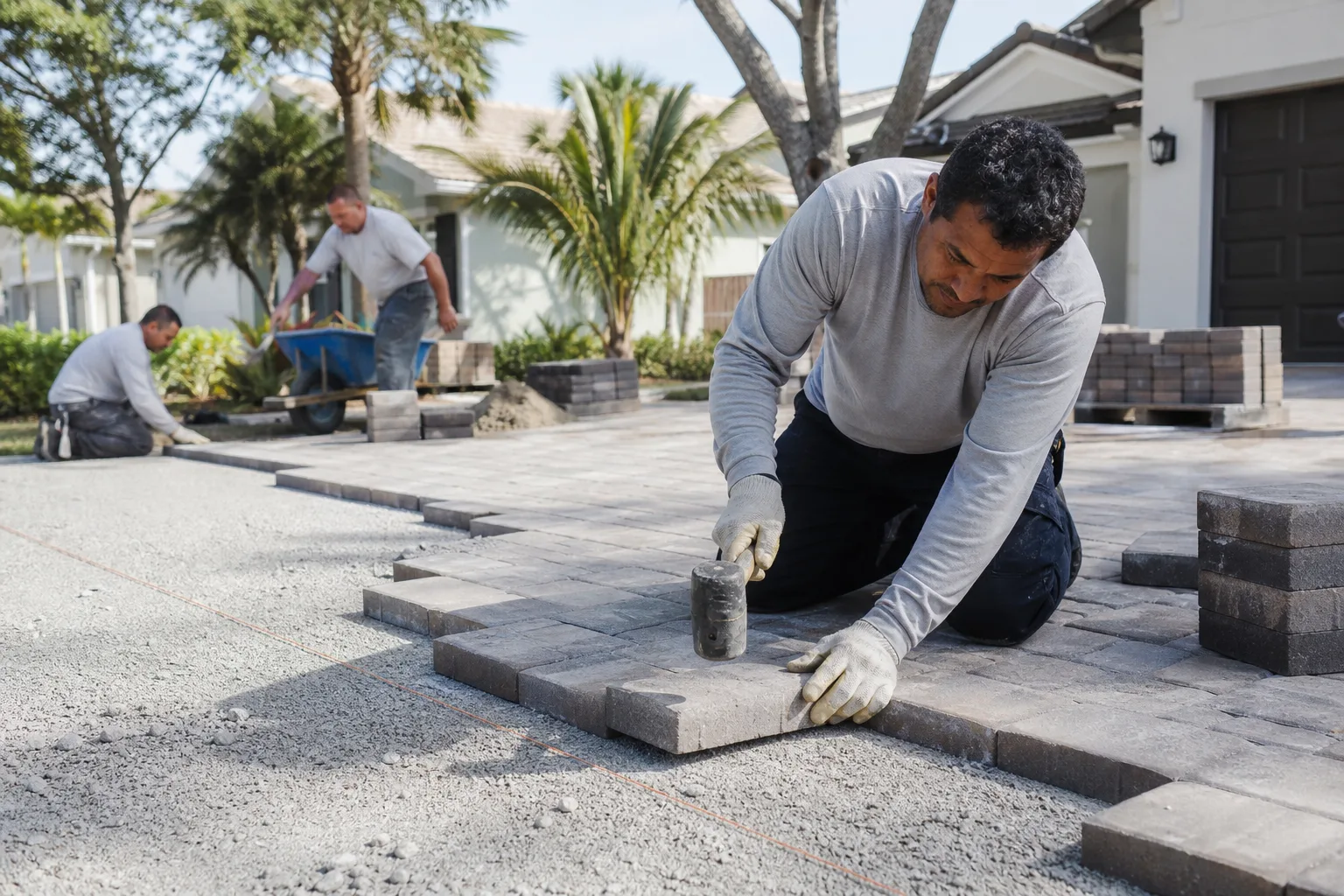
If you’re going to keep one part of the job, keep this one. Pattern laying is the part of paver work that rewards patience and punishes rushing, and both of those are within your control.
What you actually need to succeed here:
- A rented wet saw with a diamond blade. Around $75 to $120 a day from a local tool rental in the Las Vegas Valley. Dry-cutting with an angle grinder will work for a handful of cuts and then bury you in dust and shattered pavers.
- Patience for the first 100 square feet. Herringbone clicks after you’ve laid a few rows. The first hour is slow.
- An accurate string line and a straight edge. Cheap, and they save you from that wavy-row look that’s a dead giveaway of a first-time install.
- Proper joint spacing. Pavers are supposed to sit tight against each other, with joint sand filling the chamfered edges, not wide gaps you sweep full of sand.
Set aside a full weekend to lay a 400 square foot driveway with borders and at least one curved edge. Cut all your border pieces first, then lay the field, then cut and set the transition. That sequence alone will save you half a day of rework.
When you’re ready to source materials, we can walk you through Driveway & Pavers in Sunrise Manor – we stock and install Techo-Bloc, Cambridge Pavers, and Oldcastle, and we’ll quote materials and installation together so you can compare honestly.
Permits and Grade Inspection in Clark County
This is the part of the job that surprises most DIYers: a new or significantly reconfigured paver driveway in Clark County typically requires a permit through Clark County Public Works, and it requires a final inspection on the grading and connections. That’s not a border the contractors invented to justify a fee. The permit exists because driveways connect to public right-of-way, affect drainage onto neighboring properties, and interact with the sidewalk and curb cut.
What homeowners get wrong here:
- Assuming permits are optional. They aren’t. We hear it every week: the last crew told them a permit wasn’t needed. That’s the story that ends in a stop-work order or a lien on the property at resale.
- Pulling the wrong permit. A flat-work permit for a patio is different from a residential driveway permit. They cover different drainage and right-of-way concerns.
- Failing inspection on grading. The most common inspection failure on a driveway is slope away from the structure or a curb-cut elevation mismatch. Those get caught at inspection and cost more to fix after the pavers are set.
If you’re going the DIY route, call the county before you dig. Find out whether your specific project needs a permit, and if it does, pull it. The permit inspector works for you, not for me – that’s exactly why I like him. The inspection is the cheapest insurance you’ll ever buy on a driveway that has to last 25 years.
The Honest Math on a 2-Car Sunrise Manor Driveway
Here’s a realistic cost breakdown for a 400 square foot two-car driveway, DIY vs. professional, in the Sunrise Manor market. Numbers are rounded to give you a fair swing at a real budget.
- Paver material. $4.50 to $7.50 per square foot for a mid-grade concrete paver from a brand like Techo-Bloc or Cambridge. Call it $2,000 to $3,000 installed quality material, before waste. Add 8% to 10% for cuts and breakage.
- Aggregate base material. $350 to $550 for 130 to 160 cubic yards of Class II base, delivered. More if you’re in an area that requires haul-away of the excavation spoils.
- Bedding sand and joint sand. $100 to $180 total.
- Edge restraint. $80 to $150.
- Tool rentals. Plate compactor: $70 to $110/day. Wet saw: $75 to $120/day. Skid steer if you’re smart: $250 to $350/day. Plan on at least 4 rental days. That’s $600 to $1,200 in rentals alone if you rent the right equipment.
- Waste and rework. Assume 10% to 15% of material as rework on a first-time install. On a $3,000 material bill, that’s $300 to $450 you won’t get back.
- Your time. Two full weekends of pattern work, plus a week of excavation and base prep, plus multiple trips to the rental yard. Figure 12 to 16 full working days.
The DIY total often lands around $4,500 to $6,500 in materials and rentals for a driveway that’s actually built properly, before you count the cost of your own weekends. A professional installation on the same 400 square feet in Sunrise Manor routinely runs $9,000 to $14,000, and it comes with a base that’s built to spec, a permit pulled, an inspection passed, and a written warranty on the work.
The gap isn’t as wide as people assume once you allow for rentals and waste. Which is why we’ve seen the hybrid model below work more often than a full DIY project on a driveway this size.
The Hybrid Model That Actually Works
If you want to be involved but don’t want to rebuild your driveway twice, this is the model we’ve seen go right in Sunrise Manor more times than either extreme. It splits the job at the exact line between forgiving and unforgiving work.
- Hire out the excavation, base, and drainage grading. This is the part that requires equipment and can’t tolerate a learning curve. Get a crew to dig, lay fabric, place and compact base in lifts, and grade for drainage. It also means the permit is pulled by a licensed professional who knows the county’s requirements.
- Handle the pattern laying yourself if you want to. Once the base is compacted and inspected, you can rent a wet saw and lay pavers over the weekend. This is the part that’s genuinely fun.
- Bring a pro back for edge restraints and final compaction. The edge is structural. The final plate compaction after joint sand matters. Either hire it or use the right equipment.
- Do your own sealing next season. Once the install has settled a full year, sealing is a roller and a dry day.
We’ve done exactly this split with homeowners in Sunrise Manor who wanted to be on the driveway for the fun part. It keeps the customer involved where skill is learnable and hands off the parts where a mistake would cost them years. If you’re building out the broader property at the same time, our Fence Installation in Sunrise Manor work pairs naturally with a driveway replacement since the two share drainage lines and access routes.
Common Mistakes to Avoid
- Under-excavating because the digging is hard. If you stop at 5 inches because your back gave out, the pavers will telegraph that decision within two summers. The base depth isn’t a suggestion.
- Skipping compaction between lifts. Dumping all 8 inches of base at once and compacting the top surface is the most common DIY error we see. The bottom half never gets dense, and the whole driveway settles unevenly.
- Setting slope toward the house instead of away. Easy mistake with a string line on a hot afternoon. Also the most expensive one, because fixing it after the pavers are laid means pulling the driveway back up.
- Using dry-cut blades on decorative pavers. Dry cuts leave ugly chip-outs on the exposed edges, and they don’t handle curves cleanly. Rent the wet saw for the whole day you need it.
- Dragging the job out across multiple weekends. An open excavation in Sunrise Manor sits exposed to wind-blown dust and the occasional monsoon for days. Base material gets contaminated and needs reworking. Do the base work in one continuous push.
- Buying pavers without ordering waste. Order 8% to 10% more than your calculated square footage for cuts and breakage. Running out mid-project and finding a different dye lot is a real problem with concrete pavers.
- Assuming permits are optional. We’ve heard every version of that story. A driveway permit through Clark County isn’t a paperwork exercise – it’s how the grading and drainage actually get checked.
If you’re also thinking through the rest of the property this season, our guide to Home Additions & ADU in Sunrise Manor covers the permits and site access questions that overlap with driveway work.
See the difference
 Before
 After
 Before
 After
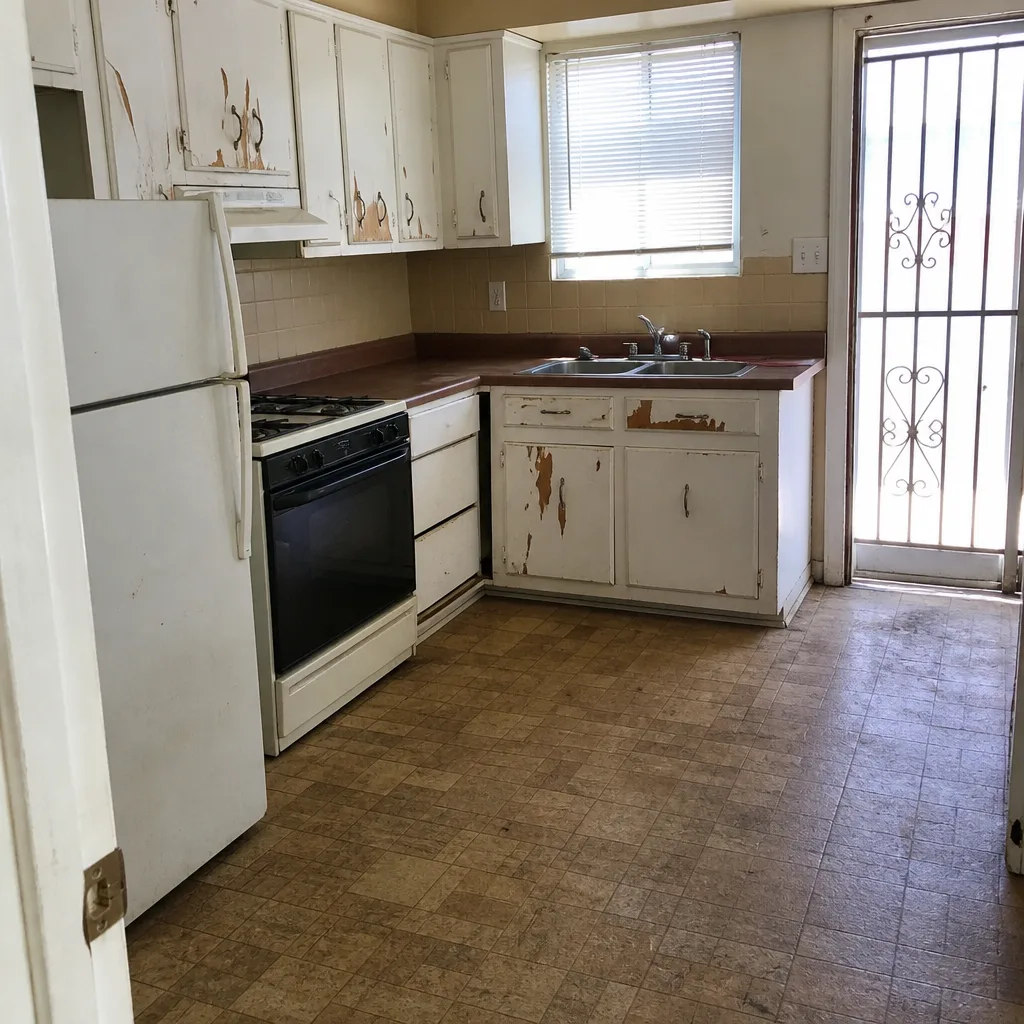 Before
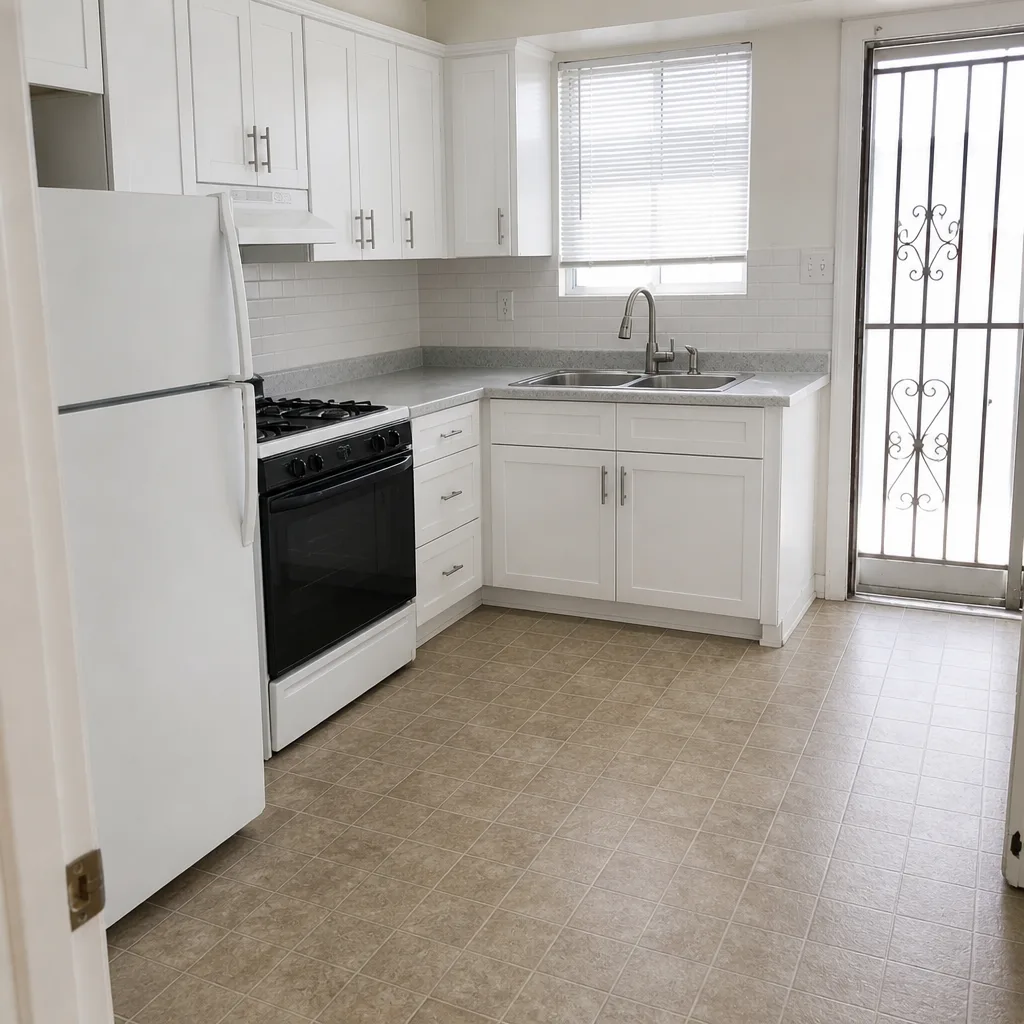 After
When to Call a Professional
Call a professional if your driveway is over 300 square feet, if the existing surface has to be demolished, if the site slopes more than about 6 inches across the length, if the driveway connects to a public street with a curb cut, or if the project is part of a larger renovation. Any of those turns the base phase from a weekend project into one where getting the grading and permit wrong costs more than the entire job.
Barrett & Sons Construction Sunrise Manor offers free estimates in Sunrise Manor – call (844) 312-0069. We’ll quote the base and the finish work separately if you want to split the job, and we’ll give you a written scope, written allowances, and a written change order before anything moves. Our crews have up to 28 years of experience, and every eligible job comes with permits pulled and inspections signed.
Frequently Asked Questions
Usually no, if the driveway connects to the public street or changes the drainage pattern. A new or significantly reconfigured paver driveway in Clark County typically requires a residential driveway permit through Public Works, plus a grading inspection. Call the county before you dig, or have the contractor pull the permit for you.
DIY is cheaper on paper and roughly even once you account for tool rentals, waste, and rework on a typical 400 square foot two-car driveway. Realistic DIY lands around $4,500 to $6,500 for materials and rentals, and a professional install in Sunrise Manor runs $9,000 to $14,000 all-in, including permit, base, inspection, and warranty. The savings depend on whether your base holds up. Call (844) 312-0069 for an exact quote on your driveway – estimates are free.
Base excavation and compaction. A rented plate compactor and hand digging can’t reliably hit proper density on a full driveway base in Sunrise Manor’s soil, and the failure shows up years later as settling and joint separation. Pattern laying and cutting are the easy parts by comparison.
A typical 400 square foot two-car driveway is a 3 to 5 day job for a professional crew, including demolition, excavation, base work, pattern laying, edge restraint, and final compaction. Permit approval time runs separately and varies by project scope. Ask for the schedule in writing along with the scope.
Not without your signature. At Barrett & Sons Construction Sunrise Manor, every scope, allowance, and price change arrives as a written change order before work proceeds – no surprise invoices at the end. The whole point of a written change order is that the number you agreed to is the number that shows up on the final bill.
Yes, on every eligible job. We pull the Clark County permit, schedule the inspection, and deliver a signed inspection report when the work is done. If a homeowner wants to do the finish work themselves, we can still handle the permit and base so the inspection passes on the first try.
If you’re comparing this against your fence or other boundary work as part of the larger property plan, our Barrett & Sons Construction Sunrise Manor home page lays out how the trades connect. And every completed driveway comes with our written 90-Day Done Right Promise – if something isn’t right in the first 90 days, one call brings us back to make it right. Ask about the $40 Off Any Repair Over $200, the Free Second Opinion on Any Written Estimate, No Trip Charge Inside the County, and the permanent 10% Senior & Veteran discount.
The Bottom Line
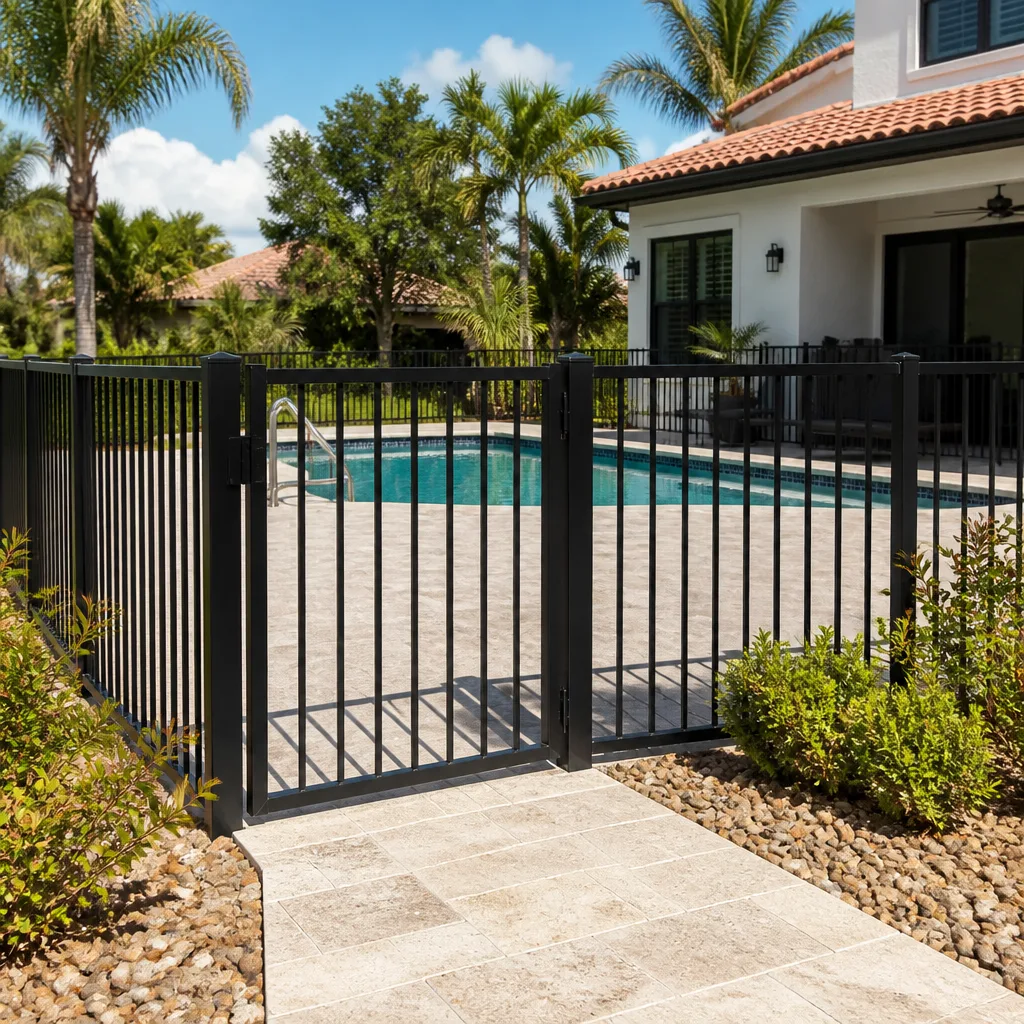
The DIY question on a paver driveway comes down to which phase of the job you’re doing. Pattern laying, cutting, joint sanding, and sealing are learnable, forgiving, and genuinely enjoyable on a weekend. Base excavation, compaction, drainage grading, and the Clark County permit inspection are not – they’re invisible once finished, they fail slowly, and they fail expensively. If you want the honest recommendation for a two-car driveway in Sunrise Manor: hire out the base and the permit, do the pavers yourself if that’s your idea of a good weekend, or hire the whole thing and be done in a week. The hybrid model is what we’ve seen work best.
Call (844) 312-0069 for your free estimate. We’ll walk the property, quote the base and finish work separately, and give you the straight answer on what’s worth your time and what’s worth ours.
Written by the team at Barrett & Sons Construction Sunrise Manor.